This page describes the set of technical terms used in the context of the eTIR Procedure and eTIR specifications that must be well understood by all TIR stakeholders using the eTIR procedure.
- eTIR base concepts:
- The TIR and eTIR procedures are intended to facilitate border crossing specifically for transit customs procedures.
- Any given TIR transport, executed under the eTIR procedure, relies on:
- A TIR transport guarantee (eGuarantee) to be procured by an authorized TIR carnet holder from a National Association.
- Advance TIR/amendment data (pre-declaration) to be submitted by the holder to the relevant competent/customs authorities.
- A declaration to be recorded by the customs of the departing country/customs territory in the eTIR International System.
- TIR operations (sections/legs) to be started/terminated/discharged by the customs in eTIR International System.
- A TIR transport guarantee (eGuarantee) to be procured by an authorized TIR carnet holder from a National Association.
- The TIR and eTIR procedures are intended to facilitate border crossing specifically for transit customs procedures.
- eTIR Stakeholders:
- Holder / TIR carnet holder: person who has been issued a TIR Carnet/eGuarantee under the rules of the TIR Convention and in whose name a customs declaration is made to place goods under the TIR procedure at the customs office of departure. He/she is responsible for presenting the transport means and equipment, together with the goods and the corresponding TIR Carnet/eGuarantee, at the customs office of departure, at any customs offices along the route, and at the customs office of destination. The holder must also ensure that all other relevant requirements of the TIR Convention are properly followed.
- Holder / TIR carnet holder: person who has been issued a TIR Carnet/eGuarantee under the rules of the TIR Convention and in whose name a customs declaration is made to place goods under the TIR procedure at the customs office of departure. He/she is responsible for presenting the transport means and equipment, together with the goods and the corresponding TIR Carnet/eGuarantee, at the customs office of departure, at any customs offices along the route, and at the customs office of destination. The holder must also ensure that all other relevant requirements of the TIR Convention are properly followed.
à In other words: transport company authorized to perform TIR transports (must be recorded in the International TIR Data Bank).
- Competent/customs authorities (or national administrations) in charge of the execution of the TIR procedure on behalf of the Contracting Parties to the TIR conventions (must be interconnected with the eTIR International System).
- National association / Guaranteeing Association: national road association approved by the customs authorities of a Contracting Party to act as surety for persons using the TIR procedure (must be recorded in the International TIR Data Bank), and to issue them TIR Carnets or eGuarantees.
- International organization: entity authorized by the TIR Administrative Committee, to take on responsibility for the effective organization and functioning of an international guarantee system.
- Guarantee chain: system covering the liabilities of national associations, authorized to act as surety for TIR Carnets issued by them as well as for liabilities incurred by them in connection with operations under cover of TIR Carnets issued by foreign associations affiliated to the same international organization as that to which they are themselves affiliated.
àIn other words: national road transport associations and international guaranteeing association issuing TIR transport guarantees, managing claims and operating TIR transports. (must be interconnected with the eTIR International System)
- UNECE TIR secretariat: United Nations body in charge of administrating the TIR Convention and of enforcing its procedure and provisions (must maintain the eTIR International System, the ITDB, and facilitate interconnections with all stakeholder information systems).
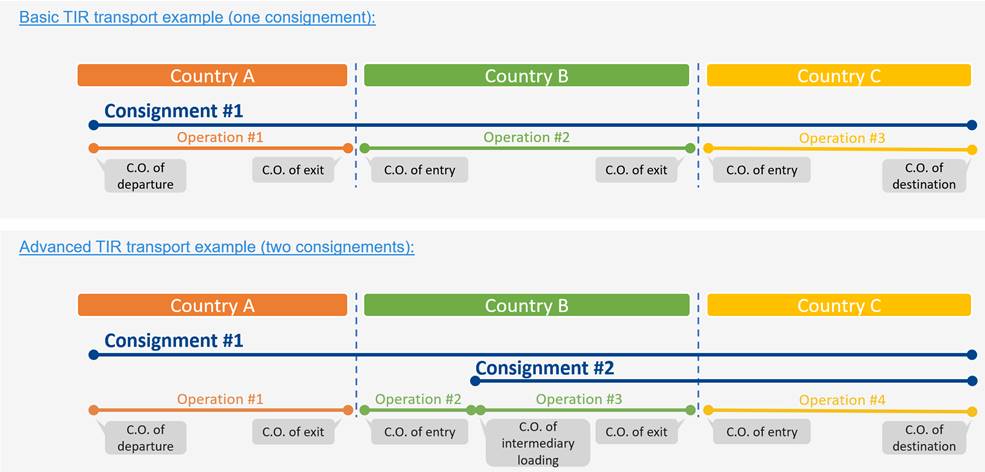
- (TIR) Transport: entire international transport of goods from a customs office of departure to a customs office of destination under the TIR/eTIR procedure, (composed of several TIR operations).
- (TIR) Operation: TIR transport section/leg within a country/customs territory,starting when entering a customs territory or loading goods, and terminating when exiting a customs territory or unloading good. .
- eGuarantee: electronic guarantee issue by a Guaranteeing association to a Holder in the context of the eTIR procedure (replacing the TIR Carnet issued in the TIR procedure context).
- Consignee: person receiving goods.
- Consignor: person consigning goods on behalf of the TIR Carnet holder.
- Consignment: TIR transport part describing a group of “consignment items” transported from one country/customs territory to another by a given transport equipment (a transport may have one or more)
- Consignment item: consignment sub-element describing packages of a consignment.
- Goods: commodity, merchandise.
- Container: article of transport equipment (liftvan, movable tank or similar structure):
- fully or partially enclosed to constitute a compartment intended for containing goods.
- of a permanent character and accordingly strong enough to be suitable for repeated use
- specially designed to facilitate the transport of goods by one or more modes of transport without intermediate unloading
- designed for ready handling, particularly when being transferred from one mode of transport to another.
- designed to be easy to fill and to empty.
- having an internal volume of one cubicle meter or more.
- fully or partially enclosed to constitute a compartment intended for containing goods.
- Heavy or bulky goods: any heavy or bulky object which because of its weight, size or nature is not normally carried in a closed road vehicle or closed container.
- Transport equipment: non-motorized sealed transport compartment containing the goods, to be pulled/carried by a transport mean (can also be combined with it), for example: a container or trailer.
- Transport means: motorized road vehicle moving the transport equipment/goods (can also be combined with the transport equipment), for example: a tractor unit.
- Customs territory: Contracting Party territory (country or customs union) where the same customs rules apply under the TIR Convention, allowing a TIR transport, once accepted by customs, to move freely within that area without further customs checks or procedures.
- Customs office of …
- Departure: customs office where a TIR transport (or consignment) starts (often also the goods loading point)
- Destination: customs office where a TIR transport (or consignment) ends (often also the goods unloading point)
- Entry: customs office where a holder enters a transit/destination country/customs territory in a transport (also where a TIR operation starts)
- Exit: customs office where a holder leaves a departure/transit country/customs territory in a transport (also where a TIR operation ends)
- Intermediary loading/unloading: customs office within a country/customs territory where a holder loads/unloads goods
- Departure: customs office where a TIR transport (or consignment) starts (often also the goods loading point)
- Start: presentation of the transport means and equipment, for purposes of control to the customs office of departure or entry (en route) together with the load and the TIR Carnet/eGuarantee number.
à In other words: action of recording the beginning of one TIR operation in the eTIR procedure.
- Terminate: presentation of the transport means and equipment, for purposes of control to the customs office of destination or of exit (en route) together with the load and the TIR Carnet/eGuarantee number.
à In other words: action of recording the end/completion of one TIR operation (previously started).
- Discharge: recognition by customs authorities that the TIR operation has been terminated correctly in a country/customs territory. This is established by the customs authorities on the basis of a comparison of the data or information available at the customs office of destination or exit (en route) and that available at the customs office of departure or entry (en route).
à In other words: action of discharging the guarantee for a given TIR operation (previously terminated).
- Accompanying document: document (provided by customs) for the Holder to be presented for each TIR operation action.
- Certificate of approval: document certifying transport equipment for usage in sealed TIR transports.
- En-route: transit (for a country/customs territory or customs office).
- Advance TIR data: data submitted to the competent authorities of the country/customs territory of departure, in accordance with the eTIR specifications, of the intention of the holder to place goods under the eTIR procedure. In other words: pre-declaration, to be sent by the holder to the first customs of departure.
- Advance amendment data: data submitted to the competent authorities of the country/customs territory in which an amendment to the declaration data is requested, in accordance with the eTIR specifications, of the intention of the holder to amend the declaration data. In other words: pre-declaration information complement (related to a previously sent advance TIR data), to be sent by the holder to the related customs authority of loading.
- Declaration: action by the holder, or by his/her authorized representative, to formally notify the competent/customs authorities that they intend to transport goods under the eTIR procedure. Once the authorities accept this declaration (based on the received advance data), and records it in the international eTIR system, the declaration has the same legal effect as an accepted TIR Carnet.
- Fallback procedure: procedure detailed in the Annex 11 to the TIR Convention, relying on the TIR accompanying document, describing how to proceed with eTIR procedure in case of connection issue with the eTIR International System.
- Intermodal transport: transport using more than one type of transport (Road, Sea, Rails, Air, Inland Waterways…).
- Suspension: TIR transport guarantee suspension that occurs when an intermodal TIR transport is using a different type of transport than “road”.
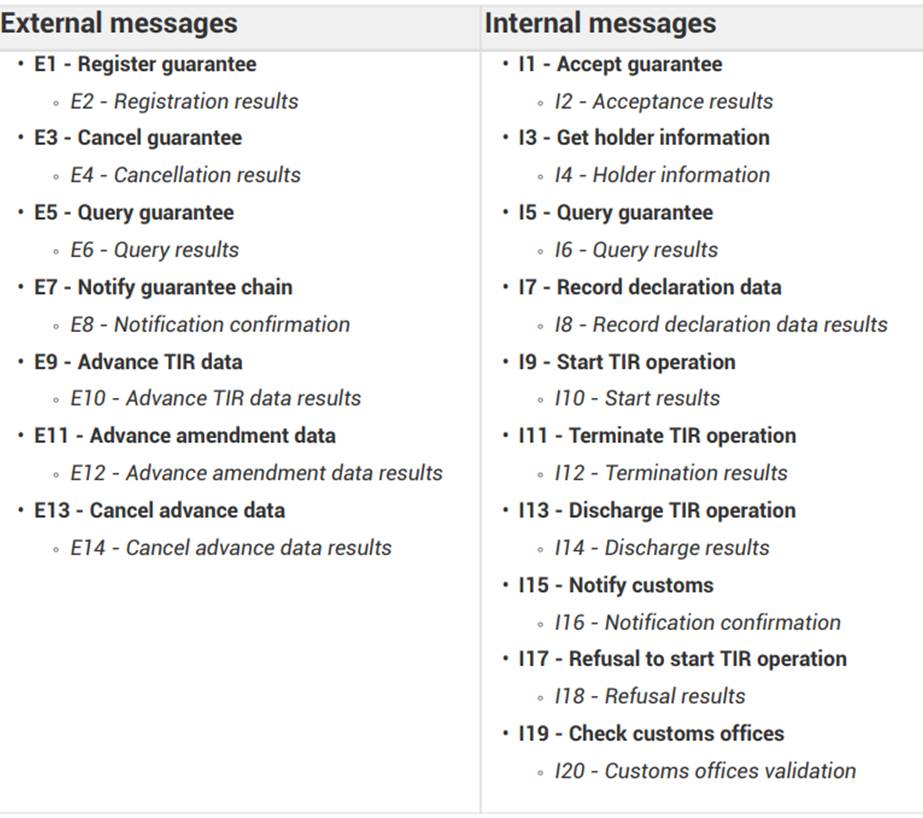
- eTIR messages: refers the list of electronic (XML) messages exchanged between the eTIR International System and other eTIR stakeholders: